 Skip to content
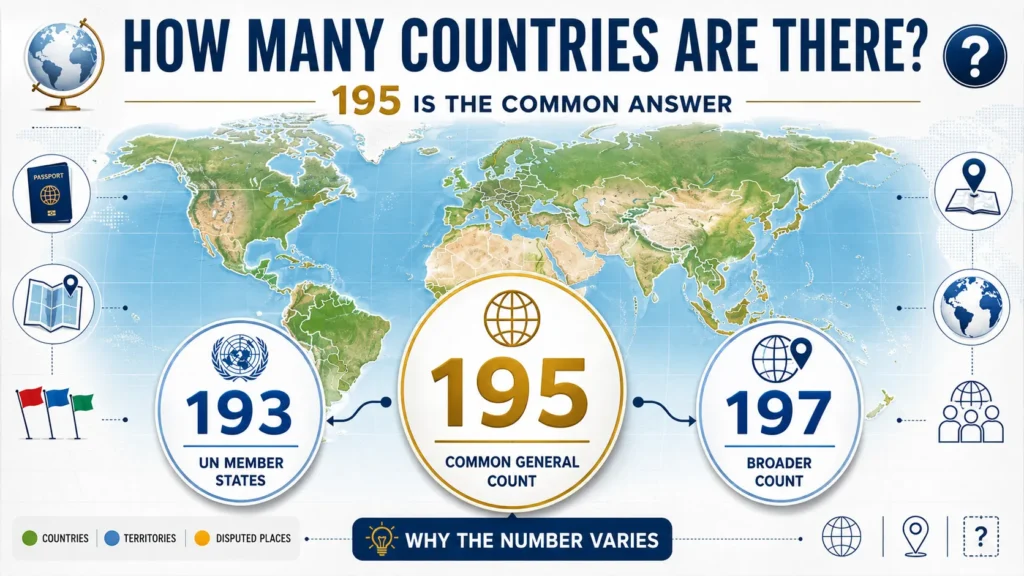
If you are asking how many countries are in the world, the most commonly used general answer is 195 countries. This includes 193 United Nations member states plus the Holy See and the State of Palestine, which have non-member observer state status at the UN.
You may also see 193, 197, 206, 211, or 249 when searching for the total number of countries. These numbers are not all counting the same thing. The difference comes from how a source defines a country, state, territory, membership, or country code.
I use 195 countries as the standard general-reference count in this guide. I will also explain why 193 and 197 appear so often and when each number makes sense.
Quick Answer: How Many Countries Are in the World?
There are 195 countries in the world by the commonly used general count: 193 UN member states plus the Holy See and the State of Palestine. If you are asking specifically for the number of UN member countries, the answer is 193.
Some broader lists include places such as Taiwan and Kosovo and therefore use 197. Other organizations have different membership or coding systems, which can produce even higher numbers.
Why Are There Different Numbers of Countries?
The question sounds simple, but the word country can mean different things depending on the list being used.
For example, the United Nations has 193 member states. It also has two non-member observer states: the Holy See and the State of Palestine. That gives the commonly used total of 195.
The confusion starts when a list adds places with limited or disputed international recognition, or when it counts territories and members of a particular organization.
This is why I would not treat every number you see online as a direct answer to the same question.
193 vs 195 vs 197 Countries

Here is the simplest way to see the difference:
| Number | What it represents | When to use it |
| 193 | UN member states | When the question is specifically about UN membership |
| 195 | 193 UN members + Holy See + State of Palestine | Best general-reference answer |
| 197 | 195 + Taiwan + Kosovo | Used by some broader country lists |
| 206 | Olympic National Olympic Committees | Sports-related comparisons |
| 211 | FIFA member associations | Football-related comparisons |
| 249 | ISO country and territory codes | Country-code and data systems |
The key point is that these numbers do not represent six different official totals of sovereign countries.
They are counts produced by different systems with different purposes.
For a normal geography question such as “How many countries are there in the world?”, I would use 195.
Why Are There 193 Countries?
There are currently 193 United Nations member states. This number refers specifically to countries that are full members of the United Nations.
So if someone asks:
How many countries are members of the UN?
The answer is 193.
That does not mean the word “country” can only be used for those 193 places. It simply describes UN membership.
This distinction matters because the two non-member observer states are not included in the 193 figure.
Why Are There 195 Countries?
The 195-country count adds two non-member observer states to the 193 UN members:
- Holy See
- State of Palestine
The UN lists both as non-member observer states. Palestine received non-member observer State status through a General Assembly resolution in 2012.
So the calculation is:
193 UN member states + 2 non-member observer states = 195
This is why 195 countries is such a common answer in general geography, education, travel, and reference material.
Is Vatican City the Same as the Holy See?
You will often see Vatican City used when discussing the 195-country count.
Strictly speaking, the UN’s observer-state name is Holy See. Vatican City is the territory associated with the Holy See.
For a simple geography article, many country lists use “Vatican City” because it is the familiar geographic name.
Why Do Some Sources Say There Are 197 Countries?
You may also see 197 countries.
The usual calculation is:
195 + Taiwan + Kosovo = 197
Taiwan and Kosovo are included in some broader country lists because they operate with many characteristics associated with states, but their international recognition and UN status differ from the 193 UN member states.
I would therefore avoid saying that 197 is the universally accepted total.
It is better to describe it as a broader counting method.
Is Taiwan a Country?
Taiwan is one of the main reasons you may see a country count higher than 195.
Taiwan has its own government, territory, currency, passport system, and institutions. However, its international political and diplomatic status is disputed, and it is not a UN member state.
This is why some country lists include Taiwan while others do not.
For a general world-country count, I would keep Taiwan separate from the standard 195 figure and explain the reason rather than silently adding it.
Is Kosovo a Country?
Kosovo is another reason some lists use 197 countries.
Kosovo declared independence from Serbia in 2008 and is recognized as a state by many countries, but not by every country. It is also not a UN member state.
For that reason, some geography and travel lists include Kosovo, while others keep it outside their standard country count.
The safest approach is to explain the classification you are using instead of presenting 197 as an uncontested number.
Why Do Some Sources Say More Than 197 Countries?

Some lists count more than 197 because they include additional entities with disputed, limited, or special political status.
These can include:
- Partially recognized states
- Disputed territories
- Self-governing territories
- Dependencies
- Autonomous regions
- Special administrative areas
- States in free association with another country
The problem is that these categories do not all mean the same thing.
A territory can have its own government or laws without being an independent sovereign state. Likewise, an organization can have a member association that does not represent a separate sovereign country.
That is why I would always check what the list is actually counting before comparing two numbers.
What Is the Difference Between a Country, State, Territory, and Dependency?

These terms are often mixed together, but they describe different ideas.
| Term | Simple meaning |
| Country | A common term for a distinct political and geographic entity |
| Sovereign state | A state with its own supreme political authority |
| UN member state | A state that is a full member of the United Nations |
| Observer state | A non-member state with observer status at the UN |
| Territory | An area that may be governed separately but is connected to another state |
| Dependency | A territory with a constitutional or political relationship with another state |
| Disputed territory | An area whose political status or sovereignty is contested |
This distinction is one of the main reasons country lists can disagree.
For example, Greenland and Puerto Rico can appear separately in geographic databases, maps, and travel resources, but that does not make them independent sovereign countries.
Are Territories Countries?
Not every territory is an independent country.
Examples include:
- Greenland
- Puerto Rico
- Guam
- Bermuda
- French Guiana
- Faroe Islands
- Hong Kong
- Macau
These places can have their own local governments, laws, borders, cultures, or administrative systems.
However, they have different constitutional relationships with other states.
This is why I would not simply add every separately listed territory to the number of countries in the world.
How Many Countries Are There by Continent?

Country counts by continent can also vary because some countries span more than one geographic region and different classification systems place them differently.
For a common six-continent geographic grouping, the approximate distribution is:
| Continent | Number of countries |
| Africa | 54 |
| Asia | 48 |
| Europe | 44 |
| North America | 23 |
| South America | 12 |
| Oceania | 14 |
| Antarctica | 0 |
These figures add up to 195 under this particular classification.
The important point is that continent counts depend on the geographic rules being used. A country such as Russia, Turkey, Kazakhstan, Azerbaijan, Georgia, and Egypt can create different totals depending on how transcontinental regions are classified.
So if you compare two continent tables and see a small difference, check the classification method before assuming one list is wrong.
How Many Countries Are in Africa?
There are 54 countries in Africa in the commonly used 195-country geographic grouping.
Africa has more countries than any other continent.
The continent includes countries such as:
- Algeria
- Egypt
- Ethiopia
- Ghana
- Kenya
- Morocco
- Nigeria
- South Africa
- Tanzania
- Tunisia
Africa also contains territories and disputed areas that are not included in the standard 54-country count.
How Many Countries Are in Asia?
A common count is 48 countries in Asia.
Asia includes countries such as:
- China
- India
- Indonesia
- Japan
- Malaysia
- Pakistan
- Philippines
- Saudi Arabia
- South Korea
- Thailand
- Vietnam
The exact total can vary because of different geographic definitions and the treatment of transcontinental countries.
How Many Countries Are in Europe?
A common geographic count is 44 countries in Europe.
Examples include:
- Albania
- Austria
- Belgium
- France
- Germany
- Greece
- Italy
- Netherlands
- Norway
- Poland
- Portugal
- Spain
- Sweden
- Switzerland
- Ukraine
- United Kingdom
Russia is a major reason geographic country lists can differ because it extends across Europe and Asia.
How Many Countries Are in North America?
Using the common geographic grouping that includes Central America and the Caribbean, North America has 23 countries.
These include:
- Canada
- United States
- Mexico
- Costa Rica
- Cuba
- Dominican Republic
- Guatemala
- Haiti
- Jamaica
- Panama
Central American and Caribbean countries are included within North America in this classification.
How Many Countries Are in South America?
South America has 12 sovereign countries in the standard count.
They are:
- Argentina
- Bolivia
- Brazil
- Chile
- Colombia
- Ecuador
- Guyana
- Paraguay
- Peru
- Suriname
- Uruguay
- Venezuela
French Guiana is geographically in South America but is not an independent sovereign country.
How Many Countries Are in Oceania?
Oceania has 14 countries in the common 195-country grouping.
They include:
- Australia
- Fiji
- Kiribati
- Marshall Islands
- Micronesia
- Nauru
- New Zealand
- Palau
- Papua New Guinea
- Samoa
- Solomon Islands
- Tonga
- Tuvalu
- Vanuatu
Oceania also contains many territories and island groups that are not independent countries.
Are There Any Countries in Antarctica?
There are no sovereign countries in Antarctica.
Several countries have territorial claims or research interests in Antarctica, but the continent is governed under a special international system rather than being divided into independent countries.
So Antarctica contributes zero countries to the standard 195-country total.
Complete List of the 195 Countries in the World

If you need the standard general list, I would organize the 195 countries by continent rather than putting them into a random numbered order.
Africa — 54 Countries
- Algeria
- Angola
- Benin
- Botswana
- Burkina Faso
- Burundi
- Cabo Verde
- Cameroon
- Central African Republic
- Chad
- Comoros
- Democratic Republic of the Congo
- Republic of the Congo
- Côte d’Ivoire
- Djibouti
- Egypt
- Equatorial Guinea
- Eritrea
- Eswatini
- Ethiopia
- Gabon
- Gambia
- Ghana
- Guinea
- Guinea-Bissau
- Kenya
- Lesotho
- Liberia
- Libya
- Madagascar
- Malawi
- Mali
- Mauritania
- Mauritius
- Morocco
- Mozambique
- Namibia
- Niger
- Nigeria
- Rwanda
- São Tomé and Príncipe
- Senegal
- Seychelles
- Sierra Leone
- Somalia
- South Africa
- South Sudan
- Sudan
- Tanzania
- Togo
- Tunisia
- Uganda
- Zambia
- Zimbabwe
Asia — 48 Countries
- Afghanistan
- Armenia
- Azerbaijan
- Bahrain
- Bangladesh
- Bhutan
- Brunei
- Cambodia
- China
- Cyprus
- Georgia
- India
- Indonesia
- Iran
- Iraq
- Israel
- Japan
- Jordan
- Kazakhstan
- Kuwait
- Kyrgyzstan
- Laos
- Lebanon
- Malaysia
- Maldives
- Mongolia
- Myanmar
- Nepal
- North Korea
- Oman
- Pakistan
- Palestine
- Philippines
- Qatar
- Saudi Arabia
- Singapore
- South Korea
- Sri Lanka
- Syria
- Tajikistan
- Thailand
- Timor-Leste
- Türkiye
- Turkmenistan
- United Arab Emirates
- Uzbekistan
- Vietnam
- Yemen
Europe — 44 Countries
- Albania
- Andorra
- Austria
- Belarus
- Belgium
- Bosnia and Herzegovina
- Bulgaria
- Croatia
- Czechia
- Denmark
- Estonia
- Finland
- France
- Germany
- Greece
- Hungary
- Iceland
- Ireland
- Italy
- Latvia
- Liechtenstein
- Lithuania
- Luxembourg
- Malta
- Moldova
- Monaco
- Montenegro
- Netherlands
- North Macedonia
- Norway
- Poland
- Portugal
- Romania
- Russia
- San Marino
- Serbia
- Slovakia
- Slovenia
- Spain
- Sweden
- Switzerland
- Ukraine
- United Kingdom
- Vatican City
North America — 23 Countries
- Antigua and Barbuda
- Bahamas
- Barbados
- Belize
- Canada
- Costa Rica
- Cuba
- Dominica
- Dominican Republic
- El Salvador
- Grenada
- Guatemala
- Haiti
- Honduras
- Jamaica
- Mexico
- Nicaragua
- Panama
- Saint Kitts and Nevis
- Saint Lucia
- Saint Vincent and the Grenadines
- Trinidad and Tobago
- United States
South America — 12 Countries
- Argentina
- Bolivia
- Brazil
- Chile
- Colombia
- Ecuador
- Guyana
- Paraguay
- Peru
- Suriname
- Uruguay
- Venezuela
Oceania — 14 Countries
- Australia
- Fiji
- Kiribati
- Marshall Islands
- Micronesia
- Nauru
- New Zealand
- Palau
- Papua New Guinea
- Samoa
- Solomon Islands
- Tonga
- Tuvalu
- Vanuatu
What About the Holy See?
The Holy See is the second UN non-member observer state and is included in the standard 195-country count. It is commonly represented geographically by Vatican City in country lists.
Because the geographic grouping above uses Vatican City under Europe and Palestine under Asia, the 195 total is preserved.
Which Number of Countries Should You Use?

The right number depends on what you are trying to count.
For a general geography question
Use 195 countries.
This is the clearest general answer because it includes the 193 UN member states and the two non-member observer states.
For a question about UN membership
Use 193 countries.
This specifically describes the number of UN member states.
For a broader country list
You may see 197 if the list also includes Taiwan and Kosovo.
If you use this number, explain the additional classification rather than presenting it as the universal answer.
For sports organizations
You may see a different number because sporting bodies count their members and associations for their own competitions.
That is a membership count, not a simple worldwide census of sovereign countries.
For country and territory codes
Data systems can use even higher totals because they need to identify territories and other geographic entities separately.
This is useful for databases, addresses, shipping, statistics, and software, but it should not be confused with a simple sovereign-country count.
Why Does the Number of Countries Matter?
At first, the difference between 193 and 195 may look small.
But the distinction matters in geography, education, travel, international relations, databases, statistics, and country lists.
For example, if a quiz asks:
“How many UN member states are there?”
you should answer 193.
If a general geography question asks:
“How many countries are there in the world?”
195 is the more useful general answer.
If someone is making a travel list, they may choose a different method based on which places they consider countries.
The best answer therefore depends on the purpose of the list.
Can the Number of Countries Change?
Yes.
The total number of countries is not permanently fixed.
Political changes can affect international status, recognition, independence, or membership. A territory can become independent, states can merge, or an entity can gain or lose a particular international status.
That means a country-count article should be reviewed from time to time instead of treating the number as permanently unchanged.
For 2026, however, the commonly used general count remains 195, while the UN membership total is 193.
Are England, Scotland, Wales, and Northern Ireland Countries?

This question causes another common source of confusion.
England, Scotland, Wales, and Northern Ireland are often called the four countries of the United Kingdom in everyday and political language.
However, they are not four separate sovereign states in the standard international country count.
The sovereign state is the United Kingdom.
This is a good example of why the word “country” can have a different meaning in everyday language than it does in an international country list.
Is Greenland a Country?
Greenland is geographically a large island and has extensive self-government, but it is not an independent sovereign country in the standard 195-country count.
It is part of the Kingdom of Denmark.
This is why Greenland can appear in separate geographic, travel, or statistical lists without being added to the standard number of countries.
Is Puerto Rico a Country?
Puerto Rico is not counted as an independent sovereign country in the standard 195-country total.
It is an unincorporated territory of the United States.
It can still appear separately in travel databases, sports contexts, statistics, and other systems because those systems may have their own classification rules.
Why Don’t Country Lists Always Match?
There are several common reasons.
Different definitions
One list may count sovereign states while another counts territories.
Different political standards
One source may include Taiwan or Kosovo while another may not.
Different organizations
The UN, sporting organizations, and data systems have different membership or classification rules.
Different geographic systems
Continent and regional lists can also vary because countries can span more than one geographic region.
This is why I would always check the methodology before comparing two country lists.
193, 195, or 197: Which Is Correct?
All three numbers can appear in legitimate discussions, but they answer slightly different questions.
193 is the number of UN member states.
195 is the commonly used general country count that adds the Holy See and State of Palestine.
197 is a broader count that some sources reach by adding Taiwan and Kosovo.
So if you simply want the answer to “how many countries are there in the world?”, I would use:
195 countries.
Then I would explain the 193 and 197 alternatives if the reader wants more detail.
Final Answer: How Many Countries Are in the World?
If you need one simple answer, use 195 countries.
The calculation is:
193 UN member states + Holy See + State of Palestine = 195
If the question specifically asks for UN member states, use 193.
If you see 197, the source is usually adding Taiwan and Kosovo under a broader definition.
So the best answer is not simply about memorizing one number. I would look at what the list is counting first. For a general question about the total countries in the world, 195 is the clearest answer, while 193 and 197 explain the most common alternative counts.
Frequently Asked Questions About the Total Countries in the World
How many countries are there in the world?
There are 195 countries in the commonly used general count: 193 UN member states plus the Holy See and the State of Palestine.
Are there 195 or 193 countries?
Both numbers are used, but they describe different counts. 193 means UN member states, while 195 adds the Holy See and State of Palestine as non-member observer states.
Why do some people say there are 197 countries?
The 197 count usually adds Taiwan and Kosovo to the standard 195-country count.
How many countries are members of the United Nations?
There are currently 193 UN member states.
What are the 195 countries in the world?
The 195-country count consists of the 193 UN member states plus the Holy See and the State of Palestine.
Is Taiwan included in the 195 countries?
No. Taiwan is generally kept outside the standard 195-country count. Some broader country lists include it, which is one reason you may see a total of 197.
Is Kosovo included in the 195 countries?
No. Kosovo is generally treated separately from the standard 195-country count because its international recognition is not universal.
Is Palestine one of the 195 countries?
The State of Palestine is included in the common 195-country count as one of the two UN non-member observer states.
Is Vatican City one of the 195 countries?
Vatican City is commonly included in general country lists, while the UN uses the name Holy See for its non-member observer state.
How many countries are in Africa?
There are 54 countries in the commonly used geographic count.
How many countries are in Asia?
A common geographic count is 48 countries, although the total can vary slightly depending on how transcontinental countries are classified.
How many countries are in Europe?
A common geographic count is 44 countries, with some variation depending on geographic classification.
How many countries are in North America?
There are 23 countries when Central America and the Caribbean are included within North America.
How many countries are in South America?
There are 12 sovereign countries in South America.
How many countries are in Oceania?
There are 14 countries in the commonly used count.
Are there any countries in Antarctica?
No. Antarctica has no sovereign countries.
Is Greenland a country?
Greenland is not an independent sovereign country. It is a self-governing part of the Kingdom of Denmark.
Is Puerto Rico a country?
Puerto Rico is not an independent sovereign country. It is a territory of the United States.
Are England, Scotland, Wales, and Northern Ireland separate countries?
They are commonly described as the four constituent countries of the United Kingdom, but they are not four separate sovereign states in the standard international country count.